Thursday, 27 August 2020

Inquiry Focus Term 3

My inquiry focus has changed this term from the Engage Programme to a school wide focus on Reading.

My inquiry will focus on the CoL Achievement Challenge:

#3. Lift the achievement in Reading for all students, with a particular focus on boys and Maori students, with                         particular focus on boys and Maori students (both genders) Years 1-13.


The knowledge of phonics helps children to  work out  “ how to say the printed words”. In other words, it refers to the learners understanding which letter(s) make which sound. The learner can then use that knowledge and phonological awareness to encode(spell) and decode(read) regular words.This initial learning process is the building blocks or the foundation that children need to have to begin to read on their own and build their fluency and text comprehension.

This term our school wide focus is on Reading. The focus is to lift the achievement of students who are below the expected achievement level. Teachers have been given Professional Development (PD) to support us with this inquiry.

My Focus Group:

My focus group consists of three students,(student: T, student: KM, and student: IM). Student KM and IM started at the beginning of the year and the student T started school last year in October. They are all presently reading at Level Level 5 (Red 3).


What are my learners doing during our reading session?

I noticed that:

- Learners were engaged during the orienteering of the reader and were developing the confidence to share similar experiences as in the text. They would chat/discuss about what the picture “was telling us”

- When student IM and T would come to an unknown word they would look at only the initial letter and guess the word. Eg for home, they would look at the h sound and say here because the word here is a known word.

- All three students would sometimes just appeal or stare at me silently waiting for me to tell them the unknown word.

-When I was not looking they would skip that word and continue reading or sometimes make a few muffled sounds under their breath.

- They know most of the high frequency words and would look at the pictures to support them.

- They were confident and fluent in reading a familiar reader (previous day’s reader) and read that book with fluency.

-They have letter sound confusions for e.g. b and d confusions.

- Capital letter and little letter confusions for e.g when a sentence starts with a capital letter, And This, they are unable to read the word.


Working on over the next few weeks:

- Using Gwenneth Phillips Prompt consistently:

-I will use a voice recorder to record the reading lesson to get some input or understanding of what strategies children are using,  listen to ‘what am I saying’ and then plan accordingly.


Tuesday, 10 March 2020

My Inquiry Focus for 2020

This year I have 10 students that started school last year and 8 students started school at the beginning of the year. I have 11 boys and 7 girls. During the first few weeks of school my focus was on establishing rules and routines in our classroom.Over the past few weeks the children have formed good relationships and friendships with each other. They come to school happy and are excited to learn and be with each other. 

My inquiry will focus on the CoL Achievement Challenge:
#5. Improve the achievement of students with additional needs in the learning areas of English/key competency using language symbols and texts.


My focus is using the ENGAGE programme to teach skills to help children self regulate behaviour so that they can manage themselves.

I will use the engage programme, focussing on Literacy in Terms 1& 2 and Numeracy in terms 3 & 4.

The engage programme has three domains:

1. The Emotional (Feeling) Domain-RED
Recognising and regulating emotions, calming through breathing and movement, mindfulness.

2.The Cognitive (Thinking) Domain-Orange
Listening and playing attention, remembering instructions, blocking out distractions, fine and gross motor skills, controlling speed of movement, balance, etc.

3. The Behavioural Domain ( Doing) Domain- Green
Controlling impulses, patience, turn taking, delaying gratification.

I will be focussing on two of these domains looking at a group of children however the games will be played by everyone in the class as every child will benefit from these games. Two games are played for 10 minutes over a period of 4 weeks and them the students are assessed.

In Term One, Week 1-4 we played did:


1. Deep Breathing: Emotional/Feeling Domain
Children learn to control their breathing by filling their stomachs with air like a balloon and then breathing out slowly.

Prompt-Things you can say:
This helps us control our breaths in and our breaths out."Big slow breathing can help us to feel calm and relaxed."

Deep Breathing
Smell the flower. (Breathe in slowly)


Blow out the candle. (Breathe out slowly)


2.     Relaxation: Emotional/Feeling Domain
A fun exercise that encourage children to tense and relax different parts of their bodies according to different instructions.

Prompt-Things you could say:
"We need to relax ourselves"
"We need to take big breathes when we relax"
"It helps us to feel calm"

What have I noticed:
Playing these games consistently do help children self regulate behaviour. They look forward to playing the games. Children are beginning to use the prompts with each other for example: when working in small groups I would hear a child saying " you need to wait for your turn." After lunch eating the children would come into class and find a spot and lie down to calm themselves down."
We were reading a the story called " The Three Billy Goats Gruff." We were discussing a part of the story and the meaning of bad-tempered troll" One children said " I think the troll is angry, maybe he needs to calm down and do breathing like us." The children are making connections which is pleasing to see.

Next steps:
I will introduce two new games for Weeks 5-8. I will continue to play the breathing and relaxation games especially after playtimes or when the need arises.

Monday, 9 December 2019

Inquiry End of Year Reflections

This is what happened for my students:
At the beginning of the year I did writing following Dr. Gwyneth Phillips writing programme. iPads were used as a resource to record students ideas and then replayed to write the sentence.down in their books.This approach showed an increase in children's confidence and some children moved towards becoming independent writers.
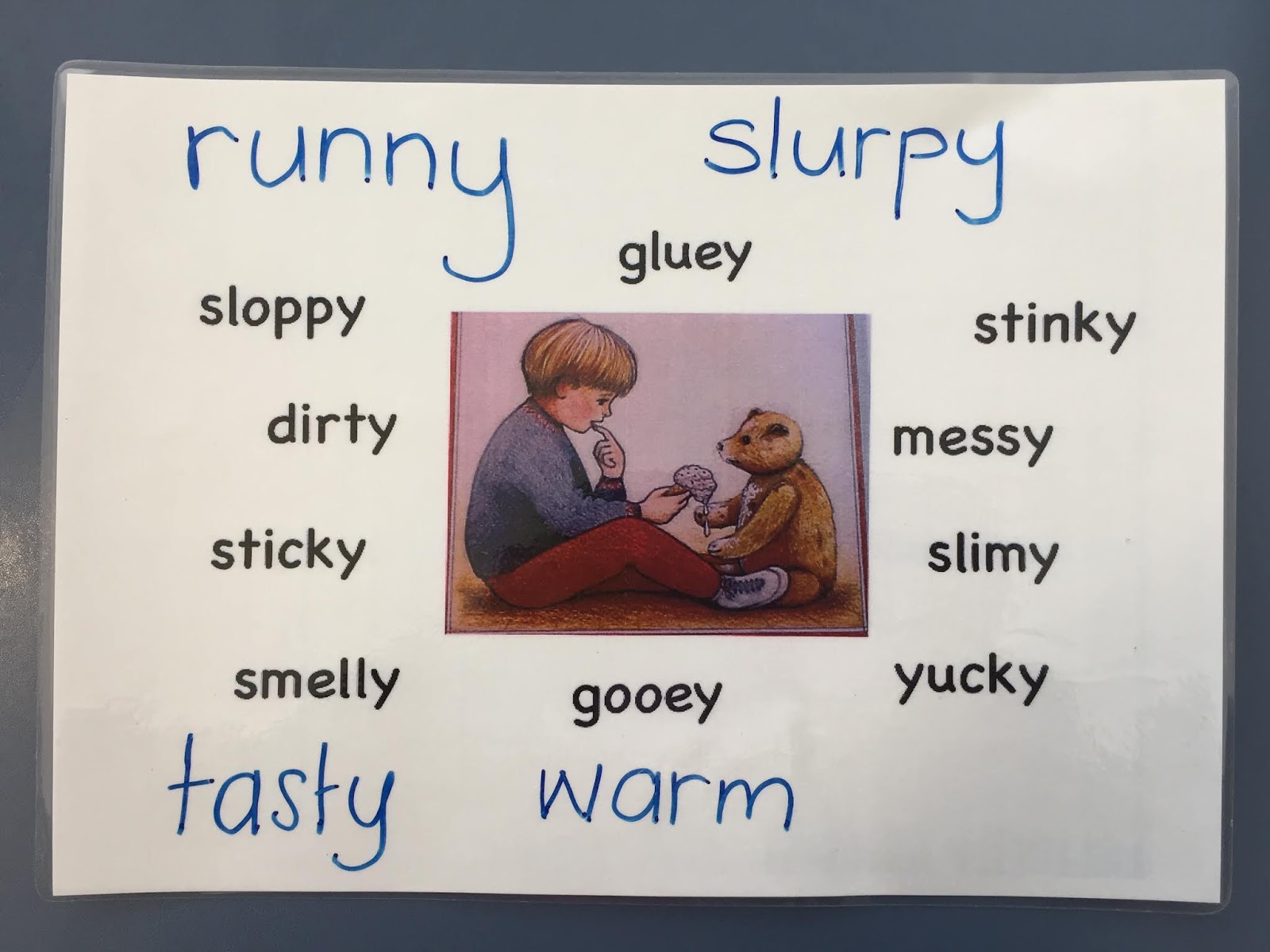
At this time I decided to change my inquiry group to students who were capable of writing a few sentences however I wanted to extend their ideas using rich topic related vocabulary. I decided to follow Dr. Jannie van Hees writing programme using visual images and gifting vocabulary and word groups.
The evidence that I have for this is:
The students writing in their books, class blog, individual blog posts, Class On Air Episodes books, e -Asstle data and Six Year Net Data.


This graph is a visual representation of data in the table above.

The data shows that overall most students in my focus group performed well.I am so very proud of them. They have worked hard this year.

Tuesday, 29 October 2019

Inquiry Term 4, Week 1

Term 4 has come way too quickly and it will be a busy term with testing, reports and prize giving items. This term our inquiry focus is "Telling stories through drama." We will be reading lots of stories and legends and then will be writing about some of them.
I will continue using a brainstorm to help children put their ideas in correct sequence.
I will use images and visuals as a resource to support learners. My focus will be on the  characters in the story and gifting lots of topic related vocabulary, word groups for characters or parts of the story.
A very useful resource:


I have used this resource in the past and I think it will be useful for my focus group. An exciting term ahead and will be interested to see how my students progress this term.

Monday, 23 September 2019

Inquiry Term 3, Week 10

I am continuing to use visual images for writing. some images are related to our Inquiry focus for the term which is "There's something in the water."

We start our writing with a whole class brainstorm:


What I have noticed in their writing:
- ideas are being repeated, words like " and , and then, because" are being repeated.
- ideas do not connect and therefore the story does not make sense.

What support did I give these students:
- each child had some one to one time with me - we brainstormed their ideas, broke them into parts, for eg what happened: first, next, after that, how would like to end your story.
- I wrote the words in their brainstorm and they used this as a guide when writing.
- children use the ideas from the brainstorm to help them write their sentences. They have to stick to it cannot change. Here in the brainstorm you said "they going to play hide and seek" "does that match with what you have written. This prompt is used in reading and DMiC which I find very helpful.

Results:


Sunday, 18 August 2019

Inquiry Term 3, Week 5

I am quite pleased with the progress the children are making in my focus group. They doing well in both Reading and reading writing.

Reading Data:


Writing data:


What's working so far:
-Using visuals images to encourage rich conversation, children are able to share ideas easily and confidently.
-Working on blends, middle, sounds and endings every morning or whenever the opportunity arises has been very useful. We refer to them all the time and keep adding to the wall. For example I know ing now this says ang, like bang, clang, sprang.
-Having all the words for my sentence in my head, repeat it 3 times before I start writing.
-Using knowledge of known words to write unknown words, often this is linked to reading. For       example I know come so I can write some. I know the 'ar' sound now I can write g ar d en.
-Read my story to 3 before me.
- Working with the teacher to edit my work- Capital letters, full stops are used in the right places.
-My story has a beginning middle and end.


Over the next few weeks I will continue focussing on what we're working on.
I want to focus on
-Words I can write for eg. I know come so I can write some, probably start doing spelling tests again.
- Read my work to see if it makes sense and edit my work with support from the teacher.
- Use BAR key when writing
B-better
A-add
R-replace

Sunday, 30 June 2019

Inquiry Term 2 Week 10

I have changed my focus group. I have five children in my focus group and they are all girls. Three of the girls have already turned 6 and they can write a sentence independently. They can spell many basic everyday words and are attempting to use their letter sound knowledge to write some difficult and tricky words.  One of the girls is reading at Green 1 L12 and the other 4 girls are reading at Blue 2 Level 10. They work well together however there are 3 girls who are quiet and shy. When prompted will share their ideas. They can have conversations and share ideas freely when in a small group.


Over the last few weeks I have been using pictures from books as a resource to help my class with their writing. I select images that will hook the children, engage them to have a rich conversation.
Sometimes images are from a story we read. I have been using Dr. Janie Van Hees gifting rich vocabulary word groups.
We start with a  visual prompt:


Who is in the picture- characters and giving them names- Baby bear, Mother bear, Mother hen
Where are they- in the deep dark forest, warm nest.
What happened- they are hungry, feeling scared.


I have also talked to the class about a BME:
Your story must have a:
Beginning
Middle
End
Some children in the class are beginning to understand what this all means.
Over the last few weeks my focus group with my support have been writing sentences with a BME.


Findings:
When writing independently:
I am noticing:

Ideas being repeated  - words being repeated,
Confusions and therefore lots of mistakes- children keep changing their ideas or cannot hold onto initial idea or does not have that entire idea in their head before they start writing.
They dive straight into what happened-  for eg- she is hungry.
It has to be their idea and I need to give them waiting time which can be a bit difficult with 14 other children in the classroom.

Next steps:
Work in small groups or I walk around as everyone writes.
Continue using our i-Pads as a resource to record our sentences- Say my sentence- listen to it and now write the words for my sentence.
Children that have a good memory can work on holding one part of their story in their head.

Activities in the classroom:
Play memory games.
Puzzles
I spy games